Specialists sometimes struggle to clearly explain what seems obvious to them, don’t they? That’s why many experts rely on science communication. The goal: making a complex subject understandable to the uninitiated. So here are our 7 keys to science communication through images, drawn from fifteen years of experience.
1. Choosing the audience
Who is the audience? That’s THE first question we ask ourselves whenever we want to communicate. The aim is certainly not to reach as many people as possible, but rather a specific audience. Because you don’t speak to a schoolchild the way you speak to an adult!
2. A good reason to communicate
Explaining a biological process? Detailing a manufacturing process? Describing how research is progressing? We can have many reasons to communicate. What matters is knowing exactly why. If it’s unclear in our minds, the result will be just as unclear!
3. A specific subject
Wanting to communicate is good. Doing so on topics that interest our audience is better. Extensive context will interest specialists, but we’ll lose part of the audience. Only a well-defined subject will capture our audience’s attention.
4. A pared-down message
Now we reach a step that some experts find difficult: distilling the message. A while ago, one of our clients wanted to explain a process that spanned around forty steps! So we pared it down, brought it together and condensed the subject to express it in six truly essential key steps. This work is the rhetoric of the image. Without it, we would have lost the attention of many people.
5. Words made visual
Remember Wallace and Gromit? The famous claymation film… Well, our method takes its cue from it. Every idea should be something you could mentally sculpt in modelling clay. In the end, whatever can’t be expressed this way, we eliminate or rework. Simplicity is our watchword.
6. Staging the scene
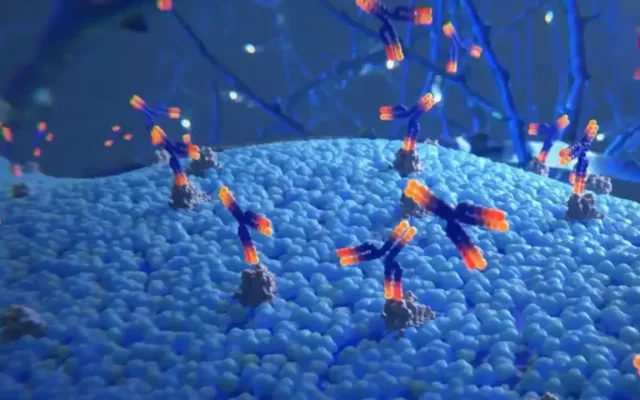
Nothing is left to chance. Objects, shapes and colours are represented by visual codes everyone understands. For example, a painful area of inflammation is usually shown in red. So we dramatise the phenomenon, even if it means taking a few liberties. Straying from reality? We own it. What matters is that it serves the message. Then it’s time for action! Our precious eyes can only follow one at a time. So we isolate each of them. And let’s not forget an important notion: rhythm. It keeps the audience on the edge of their seat.
7. An artist’s vision

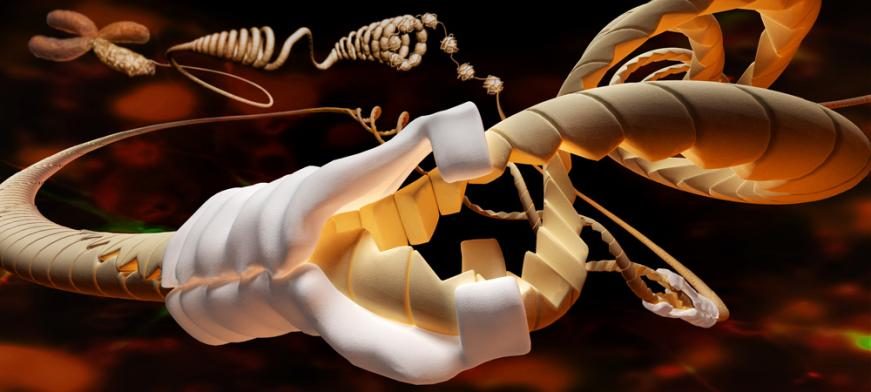
Finally, science communication is also a director’s craft. It is at once explanatory, forward-looking, but also imaginative and poetic. In the sense that it must help us transport the audience into our world. As with a painting, we carry out artistic and visual work, striving for beautiful light, perspective effects and atmosphere. And let’s never forget one thing. The audience is very demanding when it comes to image quality. When we consider a science communication project through images, the result has to be “sexy” and plausible!

Christophe Martin
Founder of Imascience