In the pharma and biotech industry, mechanism of action has never lacked supporting materials. Most often, it starts its life in a PowerPoint or a PDF: quick diagrams made in-house, arrows piled up over successive committee meetings, cascading abbreviations, screenshots pulled from publications.
For those who know the file inside out, these materials remain usable. But as soon as you widen the circle (clinicians, KOLs, affiliates, sales teams, payers), the limits show: approximate symbols, no visual hierarchy, cramped text, mediocre image quality. You set out to convey a mechanism of action, and end up communicating raw complexity.
An MOA delivered as a cluttered slide deck is not a communication tool. It's an internal memory aid dressed up as an external asset.
Behind “MOA”, diverging expectations
The three letters cover different realities depending on the team.
For R&D: signaling pathways, kinetics, secondary targets, preclinical models. Medical: alignment with publications and KOLs. Marketing: the foundation of a product story. Market access: the logic that justifies value. For the clinician, the question is more direct: “Where does this treatment change something for my patient?”
When all of this is squeezed into a few slides, you get a compromise that reassures internally but demands considerable effort from anyone who hasn't followed the project from the start.
A useful MOA doesn't start with “What should we put in the diagram?” but with “What decision should this mechanism inform, and for whom?”
From “how it works” to “why it matters”
In a classic PowerPoint approach, everything is juxtaposed: pathophysiology, molecule diagram, arrows, curve, table. Each element is valid, but none carries the overall meaning. Everything sits on the same level.
The opposite approach starts from the end: the target decision. What should this MOA enable? Legitimize earlier prescribing? Show a nuance in a saturated class? Explain a repositioning?
Once that decision is clear, the mechanism stops being an inventory. It becomes a journey. You no longer show “everything the molecule does”, but what explains the claimed clinical value.
The backbone of an effective MOA
Most MOAs that work rest on four stages:
The starting point, what happens without treatment: imbalance, an overactivated pathway, an unfavorable microenvironment. The viewer must see the problem within seconds.
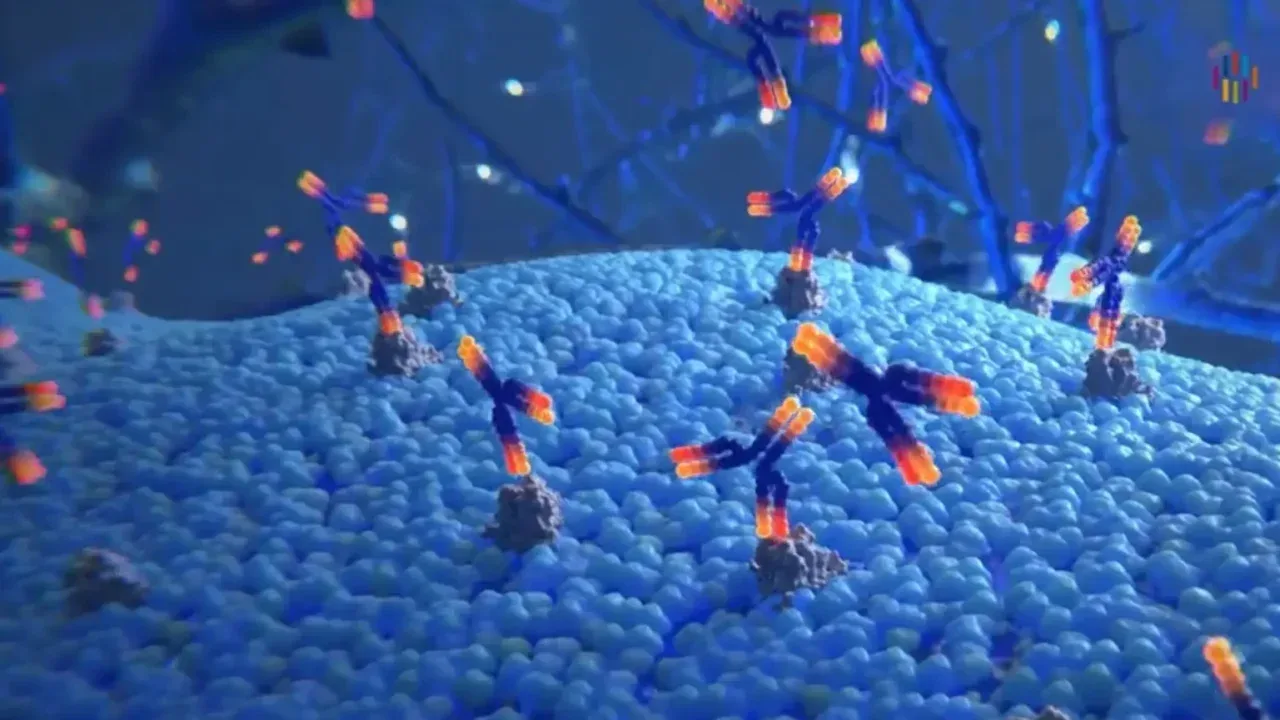
The point of leverage, the precise place where the treatment acts: receptor, enzyme, checkpoint. This is the product's action. It must be legible, almost tangible.
The relevant cascade, not every possible cascade, but the ones that connect to the central message.
The clinical translation, the return to the patient: fewer flares, improvement in a score, reduced risk. Without this bridge to the clinic, the mechanism stays abstract.
This breakdown seems obvious once stated. It's rarely visible in the original materials, where every element coexists on the same plane.
Three symptoms of an MOA stuck at the PDF stage
The encyclopedic slide, it's all there: pathophysiology, parallel pathways, biomarkers, study results. Scientifically correct. But the eye doesn't know where to enter. You don't have an MOA, you have a compressed file.
The cobbled-together diagram: approximate symbols, cropped images, arrows added across versions. This kind of diagram survives in internal meetings. It cannot serve as a reference for physicians or payers.
The mute MOA: correct on paper, but its reading depends entirely on the spoken commentary. Without the speaker, the material doesn't stand on its own.
Common thread: the form doesn't carry the meaning. The information is there, but it isn't working to shift how the treatment is perceived.
How to know whether your MOA does the job
A few simple questions:
Can a physician discovering this MOA, after a single read, sum up in one sentence what your treatment does differently?
Is the transition from the mechanistic level to the clinical level explicit?
Does the mechanism shown match your current positioning, or an older version of the file?
Can the material be broken down into excerpts, into training slides, without losing its meaning?
If several answers remain unclear, the MOA has probably stayed at the illustration stage. It describes, but it doesn't organize understanding.
Giving meaning to a mechanism of action means taking that step aside: treating the MOA not as an obligation in a communication plan, but as a strategic tool at the crossroads of science, clinic and decision.
Since 2012, IMASCIENCE has been creating visual communication content for the pharmaceutical and biotech industry: 3D animations, 2D films, interactive modules, immersive experiences.
Our approach to MOAs doesn't start with a piece of software or a graphic style. It starts with a question: who needs to understand what, and why now?
From your scientific files, we build a visual structure designed to be adapted (congress excerpts, training boards, e-learning modules) without losing the narrative thread.
An MOA is not just one more video. It's a backbone that can evolve with the life of the product.