Since the 19th century, the golden age of spreading science through journals, magazines, novels, museums and public lectures, science communication has been just as useful and essential as it is a source of debate.
By definition, making science accessible means spreading knowledge by bringing it within reach of the general public. It is this notion of the “general public” that is sometimes seen as pejorative or even discriminatory, whereas today the goal of science communication is to educate and include every kind of audience (expert or not) in scientific culture.
Here are 5 myths about science communication.
1) “Making science accessible means talking down to your audience.”
The French word for popularising science, “vulgariser,” comes from the Latin vulgare, meaning “crowd.” This term, ambiguous in its etymology, can wrongly evoke the image of a “vulgar mob” needing to be educated.
Yet today’s population is far more educated than before and no longer merely needs but has the curiosity and the right to be informed. So making science accessible means popularising it, but certainly not talking down to anyone.
In the 19th century, the science communicator and astronomer Camille Flammarion already warned of this ambiguity: “We want to popularise science, that is to make it accessible without diminishing or altering it, to all minds that understand its value and are willing to devote some attention to serious study; but we do not want to vulgarise it, to bring it down to the level of the indifferent, frivolous or mocking crowd. There is a distinction here that is not made often enough.”.
The science communicator therefore assumes they are addressing a curious, open-minded and critical, educated audience, whose education itself relies on the transmission of knowledge, and thus on science communication. Full circle.
2) “Science communication isn’t needed between scientists.”
Science communication adapts to its audience. That audience may be: an interested student, a curious child, an amateur seeking discoveries… or even an expert specialist! Indeed, it is essential for the scientific community to share its advances and discoveries even within a single research unit. Why? For the same reasons that lead researchers to give scientific talks, conferences or meetings behind a podium and a 457-slide PowerPoint. Science evolves, and the aim is to inform peers of new findings that could prove useful in their own studies. It also serves to involve collaborators and draw the attention of partners and investors to ongoing research. The Declaration on Science and the Use of Scientific Knowledge, adopted by UNESCO in 1999, indeed recalls that “the promotion of basic and applied research is essential for the achievement of endogenous development and progress.” Science communication must therefore present scientific advances by summarising them simply yet with precision.
To support their message, scientists cannot always draw on online image banks to brighten up their presentations. The available visuals often lack relevance to the research topic at hand, which is still too new or too specific to have been represented graphically. Producing up-to-date, custom content through a science communicator then becomes necessary.
It is fair to ask why scientists could not communicate their own field of study, of which they are the architect. This brings us to myth number 3.
3) “Making science accessible? Anyone can do it!”
Many think that making science accessible is just a matter of replacing scientists’ complex terms with words everyone understands. If that were the case, any scientist could simply take on the science communicator’s role themselves.
However, making science accessible takes time and requires advanced communication skills. It is a profession in its own right, in which the communicator plays a dual role. On the one hand, thanks to their specialisation, they have solid grounding in science, making them able to clearly convey a scientific idea. On the other hand, they are an outsider to the scientific topic at hand. They therefore have a broader view that lets them get straight to the point when conveying the scientific message. This dual skill set calls for a rigorous method of selecting information, one that, surprisingly, is not always intuitively applied by scientists, who are often too generous and would like to “explain everything.”
So even though the science communication specialist is best placed to convey a scientific breakthrough, this in no way excludes the scientist from the mission of sharing it. On the contrary, the scientist’s role is essential, and the work is done collaboratively. Research, discussions with several scientists… The communication process involves many exchanges.
4) “Making science accessible means taking shortcuts and stripping the subject of its substance.”
I would replace that statement with this one: “making science accessible means removing the details that hinder understanding of a subject or of a scientific message to be shared.” The work of a science communicator is indeed to distil the information to make it more accessible.
It is easy to believe that any attempt to reshape scientific language is inevitably a betrayal. But as in all communication, you have to make choices. Who are we addressing? What is the aim of the communication? For some, it is about teaching. For others, presenting the scientific method and the researchers’ approach matters more than the content of the experiment itself. Sometimes what matters is simply sparking interest or making people aware a subject exists. Anything is possible in terms of communicative purpose, as long as it remains within an ethic of sharing verified information and scientific culture.
Depending on the chosen communicative purpose (to inform, to interest, to explain in detail…), science communication will highlight certain scientific stakes and select the notions essential to understanding. It relies on writing, or even scientific storytelling, to put the subject back into its context. Let us keep in mind that the aim of any communication is to be read and/or seen. It is therefore necessary to make the message easier for the audience to take in. In this spirit, Denis Guedj wrote in his novel The Parrot’s Theorem: “The truths of science need beautiful stories for people to become attached to them. The myth, here, is not there to compete with truth, but to connect it to what people care about and what makes them dream.”
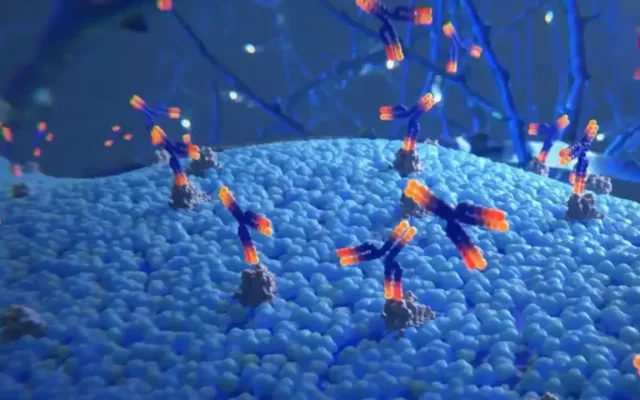
There is therefore not “one” but “many” forms of science communication, each of which can take several shapes while the scientific substance remains the same. For example, for a single scientific topic, if the goal is to explain a concept dynamically, a 3D animation video is an ideal option. If the goal is to introduce the audience to the practice of the scientific method, an immersion in a virtual reality laboratory is a fitting and enriching experience.
See examples of science communication illustrations
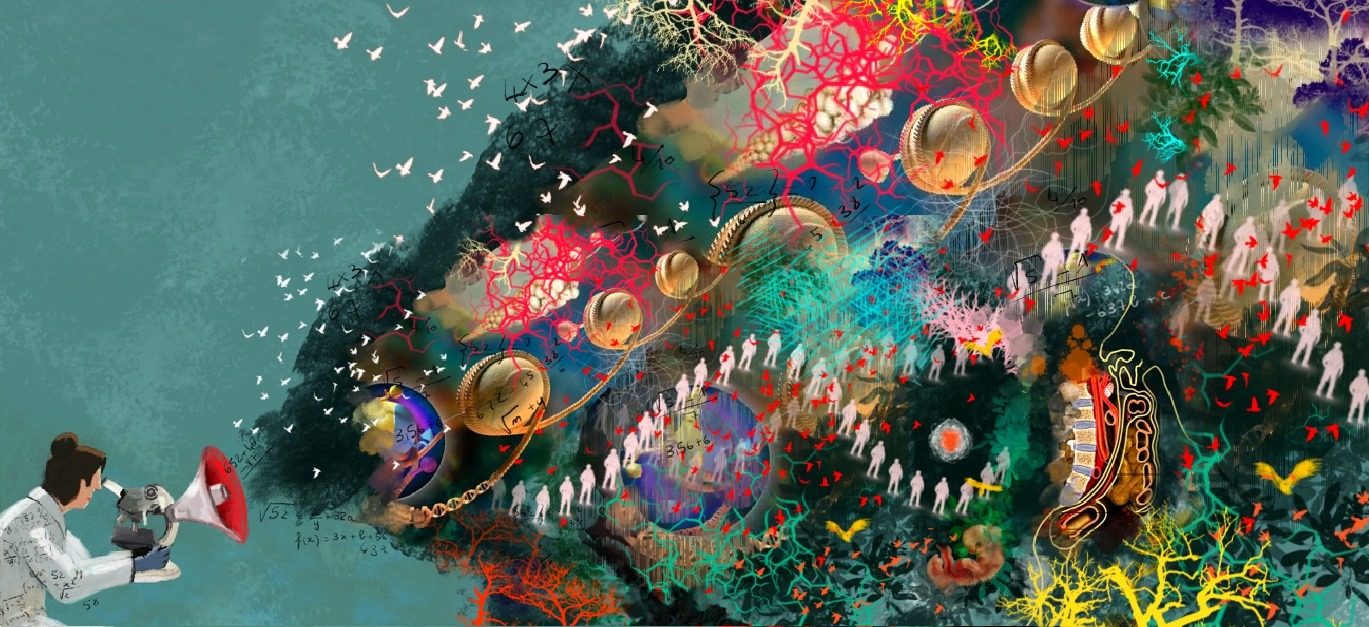
5) “The artistic dimension of science communication distorts the scientific message.”
Combining the visual arts and science has always been practised. For example, in the 1860s Ernst Haeckel linked biology and art in his depictions of radiolarians, those single-celled microorganisms. He sought in this way to put images to the existence of these biological forms invisible to the naked eye.
The artistic dimension can even be a driver to spark interest in a complex scientific subject. That is the conclusion of a study led by researcher Joanne Clavel. An advocate of “aesthetic ecology,” she studied how the public received a dance performance with scientific content at the Jardin des Plantes in Paris.
At first, it turned out that the scientific leaflet accompanying the show was barely read: spectators were first surprised by the dance performance and stopped to watch. Only once their interest was engaged did they become curious about the scientific side. 80% of spectators recognised a portrayal of birds and felt strong emotions (an average score of 3.5 on a scale from -5 to 5). This is a new approach to learning and passing on knowledge: mediation through dance evokes the aesthetic and sensory dimensions of biology and not only its classic cognitive dimension. Here, the underlying scientific work is highlighted through form.
Today, then, science communication takes many forms, adapting to the audience it is intended for. Alongside science itself, it evolves while keeping to the principle of educating and sharing information in a simple, dynamic and accurate way.
Sources:
https://theconversation.com/dix-autres-idees-fausses-sur-la-vulgarisation-scientifique-89562
https://journals.openedition.org/questionsdecommunication/368
http://www.danse.univ-paris8.fr/chercheur.php?cc_id=3&ch_id=37
http://www.unesco.org/science/wcs/fre/declaration_f.htm#savoir
HAVE A SCIENCE COMMUNICATION PROJECT?

Louise Sudour
Science Communicator
at Imascience