How can a tablet and a virtual reality headset completely revolutionize science teaching? By giving access to a virtual lab.
More concretely, how can these tools make any science course twice as effective?
The expanding field of knowledge
The field of knowledge is growing incredibly fast. And with this growth comes a substantial list of mounting challenges, such as treating diseases, global warming, fighting famine and water shortages, to name just a few.
How can we keep our promise to constantly adapt education and teaching to meet the social, political and technological advances of our time?
In the all-digital era
For a few years now we have been immersed in the all-digital era. We might think that school materials, teaching methods and learning approaches keep pace with all these upheavals and the evolution of these technologies.
But what we actually see is somewhat disappointing. We see books turned into e-books, blackboards into YouTube videos and lecture-hall monologues into MOOCs.
In reality, what we call these “new tools” amount to nothing more than taking the same content and transposing it onto another medium. Of course, all this material is within reach of a greater number of students or simple enthusiasts; it is accessible to everyone thanks to the widespread availability of the internet.
That's not so bad, you might say. But the teaching method is still more or less the same; there's no real innovation. The question to ask is: have we really become more effective? Do we learn better? Are we more responsive? More imaginative?
Personally, I don't think so.
And yet these technologies should allow us to imagine another way of learning. Innovation isn't about copying and pasting paper documents onto screens.
An experience with UIMM in Rennes
(Union of metallurgy industries and trades)
More than a year ago, UIMM in Rennes asked us to design an application to support students in their studies, particularly regarding materials treatment processes. We took time to reflect before responding.
We didn't want to build yet another pseudo-application that would ultimately be nothing more than a souped-up PowerPoint, disguised as an app with a cool design and pretty transition effects.
The starting point of our thinking
We all know from experience that we learn best and most lastingly by handling things many times and experimenting in various ways, without feeling judged for our trial and error. But how do you do that with an application?
On the trail of the simulator
For years, airline pilots have learned and trained largely on flight simulators.
Why? Because it costs less than flying an actual plane. You can repeat the procedures n times to reinforce memorization, and it's completely safe.
So we thought: why not apply this to science? Why not build a lab simulator?
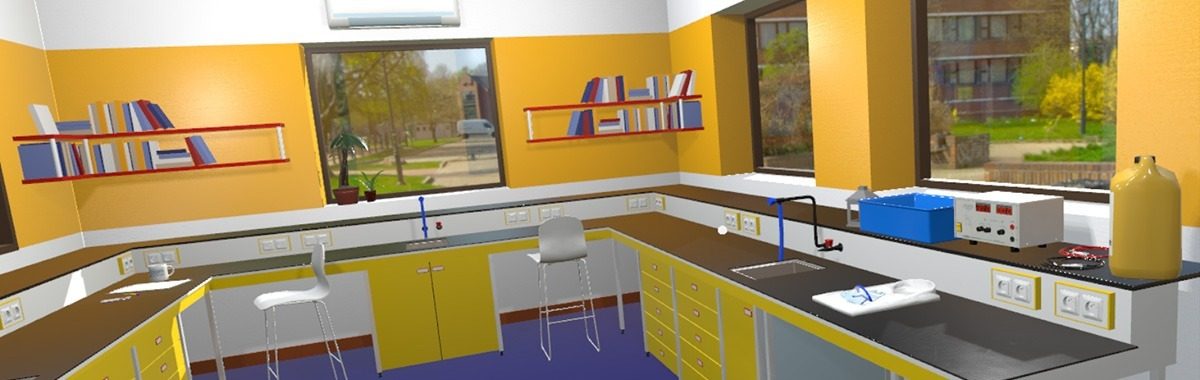
That's what we proposed to UIMM. A workbench simulator for running electrodeposition experiments. To maximize accessibility, we first developed an app for touchscreen tablets.
It contains a quiz section (fairly classic, no doubt) but above all a virtual lab in which students can build their own 3D experiments by touch and test their knowledge by running their own setups before their eyes. They can perform and repeat the operations learned in class as many times as they wish.
The educational data
To build the educational aspect of the application, we collaborated with UIMM's teaching team and instructors to bring students the real-life situations they encounter in the usual course of their studies. We refined the ergonomics as development progressed, with constant back-and-forth between the testers within the school itself and our team.
In the end, this application only requires simple Android touchscreen tablets provided by the school.
Supporting students
But this application doesn't just offer a virtual lab. For each student it records to a database their performance, progress, points of hesitation, the number of times they redo the experiments, the time they spend on them...
Students can view their own results on the tablet, or online on a dedicated site.
We also provided teachers with a complete online dashboard to track students. They know exactly where students stand and which points need reinforcing, for each exercise and each student.
What is the feedback
The feedback we received when launching the application at UIMM in Rennes was extremely positive.
We gave them evaluation charts covering 11 criteria such as playability, ergonomics and educational value… And we were surprised to find that not only did we get 100% positive feedback, but the average score given across all the application's evaluation criteria exceeded 85%.
What we take away from these experiences: what suits students are engaging, immersive tools with strong evaluation feedback delivered through gamification. For example, each student can see their ranking relative to the rest of the class. This encourages them to redo the exercises as many times as they wish, to improve their overall ranking. They learn by taking on challenges, so the goal is achieved.
The benefits of virtual reality for learning.
A Danish study
According to a study conducted at the Technical University of Denmark, learning efficiency increased by 76% using virtual labs alone, compared with traditional methods.
But when virtual labs are combined with teacher coaching and tutoring, learning efficiency increases by more than 100%, doubling the impact of the science teacher.
Saving resources
Universities could save hundreds of thousands of euros by letting students run virtual experiments before going into a real lab.
Experiments with no danger
Students can run experiments that would be dangerous if actually performed. For example, on viruses: important subjects that many schools cannot teach for safety reasons.
Travel through time and with no scale limits.
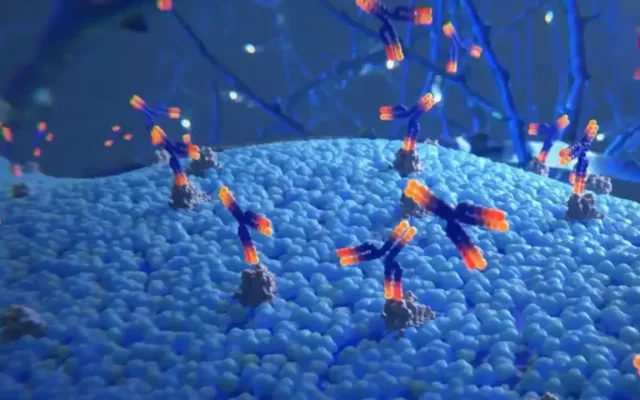
As we'll see later, students could observe everything happening at the molecular level.
Why? Because in a virtual lab, you play with time and space. You can change scale. See inside bodies and cells, speed up time…
Building storylines
We know how important giving meaning is to keeping students engaged in class. In the spirit of project-based learning, increasingly recommended in universities, we would like to create captivating puzzle scenarios. For example, giving students the chance to scientifically solve a mysterious crime using their skills.
Involving teaching teams.
Projects must be developed in close collaboration with teaching teams and institutions. The subjects covered by the applications must perfectly match what is usually done in class.
IMPORTANT: they are not meant to replace lessons. They are not a substitute for lessons. No. What these interactive 3D processes bring is greater practice with concrete cases, through hands-on manipulation and experimentation at will and without judgment (all of it, of course, under the tutoring and supervision of teachers).
What are the tools of virtual reality?
Tablet, iPad, PC, smartphone, virtual reality headset...
Applications adapt to all types of tools. Each with its own specificities and limitations.
We can produce the same application adapted for different tools.
The touchscreen tablet is inexpensive and lets one, two or three people work together. Its 3D capabilities are a bit more limited than on a PC, but it allows for good interactivity and decent smoothness.
The PC, laptop or desktop, often has a more powerful graphics card. The realism of the environment will be greater, reinforcing the sense of immersion. Like the tablet, two or three people can study around the same interface.
The smartphone has all the advantages of the tablet, but is reserved for individual use. Its mobility makes it a very attractive tool for study and revision.
The virtual reality headset is currently the best there is for immersion. Stereoscopy, panoramic vision and spatialized sound really give the feeling of being physically in the lab. Paired with a PC equipped with a 3D graphics card, the interactivity is taken very far. The sensations of grabbing and interacting with objects make it a truly privileged tool.
THE IMMERSIVE VIRTUAL LAB.
We decided to imagine and prototype a lab simulator in virtual reality, with panoramic and stereoscopic vision. A lab that could be perfectly identical to the one where students run experiments, but with mathematical equations simulating what happens in a real lab.
Today, my team is working to create this simulator, ideally including all the equipment a student can interact with for their studies.
For example, we are developing an application with which you can experiment with materials treatment by electrodeposition or chemical treatment. The environment is genuinely immersive. Students move around a real lab among workbenches. Here they have their instruments to run different experiments. A little further along there are other workbenches where they can run other experiments; further still, there's a door leading to other labs, and so on.
Constant support.
Students are not alone. They are supported in their experiments by an intelligent virtual tutor that knows where they stand, guides them and gives advice, reminders and alerts throughout their progress.
Virtual collaborative spaces
This is the obvious development we expect to be operational in the near future.
We are experimenting with the collaborative presence of several students and, why not, the teacher in the same virtual environment.
The limits of the virtual lab
The only limit is imagination. In virtual reality, as I said earlier, you can shrink yourself a million times, down to the size of a molecule. That's really the impression you get. As if you were inside the cell, for example, and could see all the DNA and molecules. You rub shoulders with DNA polymerase, primase and several other proteins. You are a privileged witness to what is really happening in the cell, just as it's happening in your body right now. You can truly feel and understand how it all works.
On the teachers' side
For us to truly stimulate and inspire the next generation of scientists, we really need teachers to guide the adoption of these new technologies in the classroom.
On the educational institutions' side
In a way, I believe the next technical advance in science teaching lies less in the technology than in the decision of institutions to push for and adopt these technologies in the classroom.
And so it is our wish that more institutions and teachers collaborate in the future with science communication companies like ours to unlock all this potential.
The future.
Now imagine we could make available to all students virtual labs that, if real, would cost hundreds of thousands of euros each, where they would have access to the best machines and experimental techniques.
Imagine how this could encourage and inspire a whole generation of brilliant young scientists, ready to innovate and, why not, change the world.