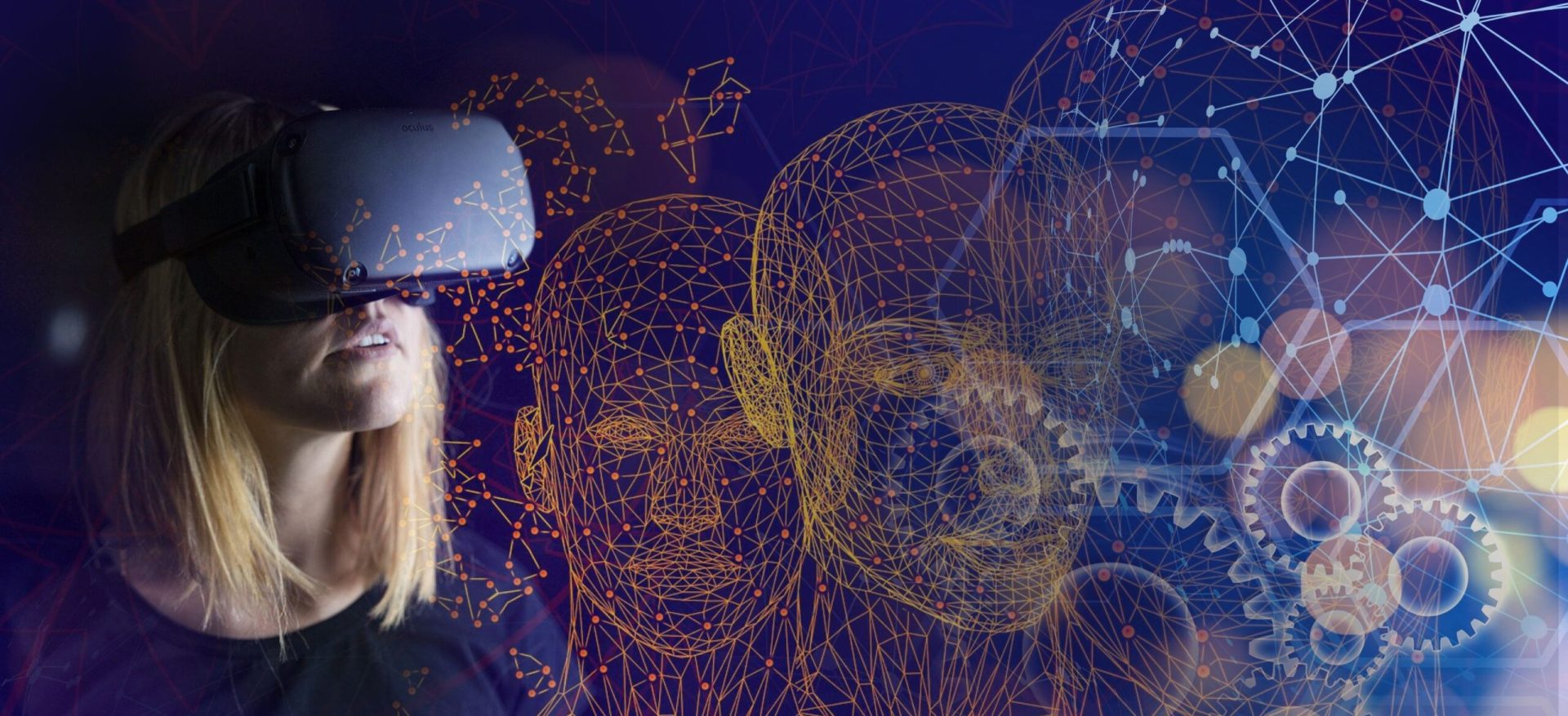
Perhaps you have already had a completely wild experience through a virtual reality headset? For a few moments you projected yourself into a virtual body and interacted with a universe entirely rebuilt in 3D.
Oculus Rift, HTC Vive or PlayStation VR… Consumer headsets are multiplying. It is increasingly common to spot the full VR headset kit at tech shows or on trade stands.
What are we going to talk about in this article?
The surprising origins of VR, its current uses, but above all, what is the future of this little headset in which so much unfolds? How far, and how, will we be able to push virtual realism? What progress can we expect in the near future? How do you make a VR application? How much does it cost? And more...
Enjoy the read.
What is virtual reality?
Virtual reality, or VR, refers to a computer technology that simulates a user's physical presence in an environment artificially generated by 3D software. VR is based on the principle of stereoscopy, a technique that aims to produce a perception of depth from two flat images. This is exactly how our brain works in a natural environment: it reconstructs a three-dimensional image from the two flat images coming from each eye. The stereoscope, invented in the 1840s, is in fact considered the earliest ancestor of the virtual reality headset.
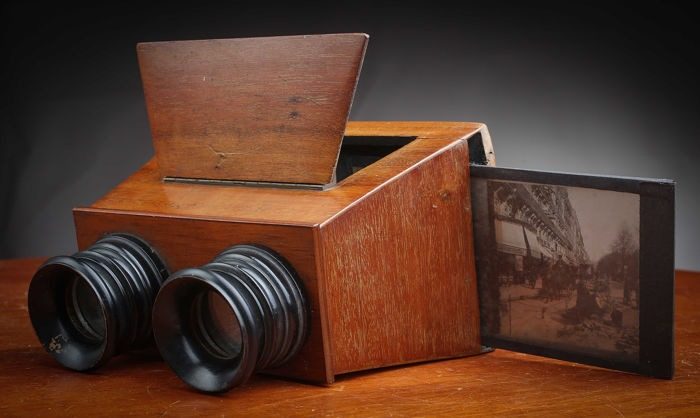
The stereoscope, invented in the 1840s
1968, the first virtual/augmented reality glasses with motion tracking, by Ivan E. Sutherland
Of course, the first attempts at 3D headsets were fairly rudimentary, and their improvement went hand in hand with their bulk. So much so that, in reference to its danger, the product of Ivan E. Sutherland's ingenuity was named the “Sword of Damocles.” In 1968 this computer scientist managed to create a headset with a built-in motion detector. As its inventor put it, “the fundamental idea behind this three-dimensional device is to offer the user a perspective image that changes as they move.” Here, reality was visible superimposed over the 3D images. So it was more an augmented reality headset than a virtual reality one (not to be confused!).
Since 2016, virtual reality has finally become accessible to the general public, at trade shows and even in our own living rooms, at home. But what is it useful for?
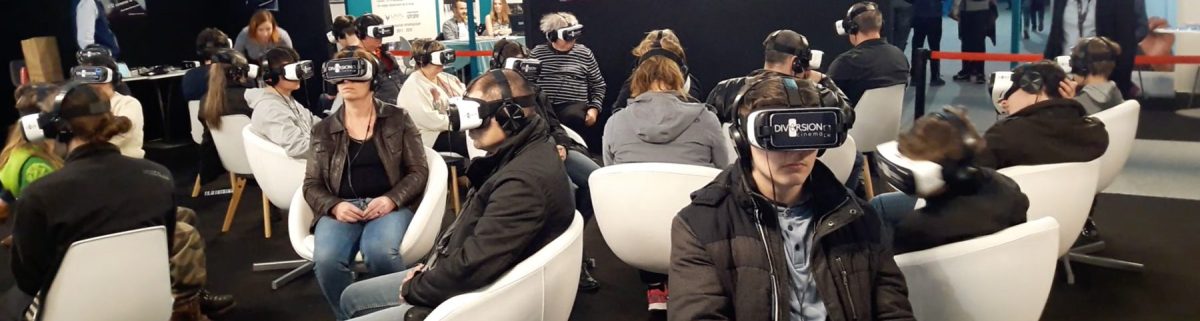
Laval Virtual in 2017: VR cinema room.
In which fields is VR used?
VR application for the Jean Lamour Institute in Nancy. The Virtual Daum is a reproduction of the “Daum Tube” laboratory, where experiments on nanoparticles under vacuum take place. The VR application lets visitors enter the virtual laboratory and interactively experience some of the experiments. An Imascience project.
Today, VR is widely used in the field of education and teaching. It is found in training rooms, schools, libraries and museums to support learning and cultural enrichment. The advantage of VR is that it makes possible experiences that would be too dangerous, rare, costly or even physically impossible in reality.
Recently, for example, NASA researchers simulated the speed and direction of several million stars in the Milky Way using VR. This technology gave them an entirely new understanding of the sky, prompting them to revise the classification of certain groups of stars in our galaxy. Astronomer Marc Kuchner came away satisfied with the experience, declaring: “Well, I'm not going to build a planetarium in my office, but I can put on a headset and I'm there.”
VR is also present in the fields of the military, industry and medicine, serving as simulators, as training for extreme situations, or to learn certain essential professional gestures.
Virtual reality is intuitively linked to the world of entertainment, particularly video games, where it lets you embody a fictional character as convincingly as possible. It also appears in the making of certain films such as Steven Spielberg's Ready Player One, and in music.
For example, for Fête de la Musique 2020, which could not really take place because of the global health conditions, Jean-Michel Jarre gave a live virtual reality concert, “Alone Together.” Using their VR headsets, spectators could move around the virtual concert hall and even chat with the artist's avatar at the end of the performance. This was a first, since VR-broadcast musical performances had always been pre-recorded until then.
Nevertheless, since some users did not have the necessary equipment at home, the event was also streamed live on platforms and social networks. Indeed, today's virtual reality requires suitable equipment that is, for now, not 100% widespread. But what will things look like in a few years? What are the future stakes of VR?
What future can we envisage for virtual reality?
VR application for Orinox. Inside a nuclear reactor. Previewing the dismantling of structures as part of maintenance operations. Project by Imascience
In its analysis report on virtual reality, the investment bank Goldman Sachs expresses its confidence in the global development of this market. By generating close to 110 billion dollars as early as 2025, the VR market could even surpass that of television, and in less than five years. So we are entering a true digital era in which the development and improvement of virtual reality (and augmented reality) will take centre stage. This quest for VR reflects the deep human desire to improve, to augment the body, even to reach toward immortality. What if we could live wherever we wished, and work remotely as if we were on site? What if we could live several lives or life experiences, as in video games?
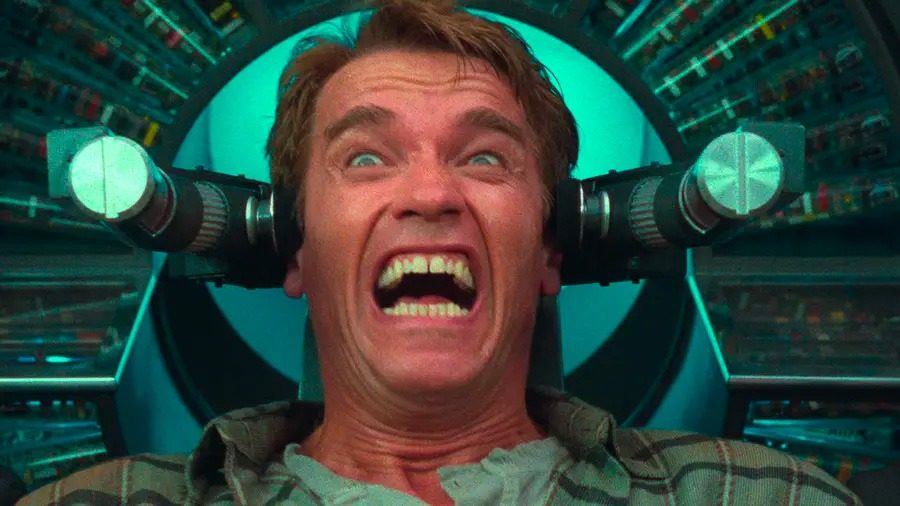
For the moment, sight and hearing (sometimes touch) are involved in virtual reality experiences. But what if all our senses were involved? What if the immersion were complete?
Above: Image from the film Total Recall (Paul Verhoeven, 1990).
Doug Quaid chooses the “secret agent adventure on the planet Mars” package. The problem: when the program starts to malfunction, it is no longer possible to know (neither for the hero nor for the viewer) whether the incident is part of the simulation or not.
Where does the research stand?
Researchers are currently prioritising technological transparency, immersion quality and interactivity by developing capture systems that can deliver a more realistic result than stereoscopy. The rapid evolution we have seen with computers and mobile phones would apply to the VR headset: researchers speak of a reduction in size over time, moving from the headset, to glasses, to the lens…
Immersion quality relies on a notion of realism. The human eye and brain must not run into a shaky virtual environment. Our brain must be fooled, made to believe that what is seen is indeed real, despite the infinite range of scenarios, some completely supernatural and fantastical.
The “sixth finger” experiment, conducted by the French National Institute for Research in Digital Science and Technology (Inria), demonstrates our ability to take ownership of a virtual body. The human brain adapts easily to an avatar… with six fingers!
Researchers have indeed clearly understood that in virtual reality, the brain can be tricked. The flaws and limits of our body are then used as a means of deception. To cite another example, the tiny “blackout” our eyes naturally perform (known as saccadic suppression) is exploited for practical purposes in VR. With each small eye movement during which the eye “does not see,” the VR application applies a slight shift of the image to the left or right. The user wearing the headset then unconsciously reorients toward that direction. In this way, researchers can force someone to walk in circles in their room while they think they are walking straight in an infinite virtual universe.
Research and experiments based on principles of illusion would therefore be the key to refining virtual reality, a technology with which humans will become increasingly familiar. The future still holds some wonderful surprises with the arrival of 5G and then 6G. What does that have to do with VR, you ask? Well, for example, we will be able to imagine VR applications in streaming. The content will load into the device as the experience unfolds. The interactions could be very numerous and far more varied. The exchanges between “virtual visitors” will be on an entirely different scale from what is done today. It will be easier to manage entire crowds of visitors in a shared setting. We will be able, for instance, to visit New York City without leaving our living room, wander through Manhattan from Central Park to the Statue of Liberty by way of the Empire State Building, all with the same online application!
HAVE A VIRTUAL REALITY PROJECT? LET'S TALK.

Louise Sudour
Science Communicator
Imascience.
Sources:
https://www.cise.ufl.edu/research/lok/teaching/ve-s09/papers/sutherland-headmount.pdf
https://www.nasa.gov/feature/goddard/2020/scientists-tap-virtual-reality-for-discovery
https://www.meilleure-innovation.com/prospective-realite-virtuelle/
https://www.youtube.com/watch?v=_fNHOBCJ64k&t=35s