We sometimes develop virtual reality (VR) applications for our clients paired with immersive headsets like the Oculus. I'm not talking about panoramic photos viewed through smartphone-mounted headsets. I mean real 3D, computed in real time and in stereo. Clients are satisfied, and the market looks promising.
And yet I still have a few questions about this kind of technology. There are several reasons for that, and I'd love to hear your take on it:
The downsides: hard to make accessible to the general public
Experience has shown me that adapting these headsets for the general public can be tricky, for several reasons:
- Thinking of setting up VR headsets for open access in a museum, for example? Forget it. They require careful guidance and a person on hand. Like a child learning to walk, you need assistance: someone sets you up, shows you how your new “toy” works, and keeps you from falling. Not exactly simple, is it?
- VR headsets give one person in four motion sickness. Immersion can make you feel ill, both during (and after) use. Some people say: I tried it once… never again.
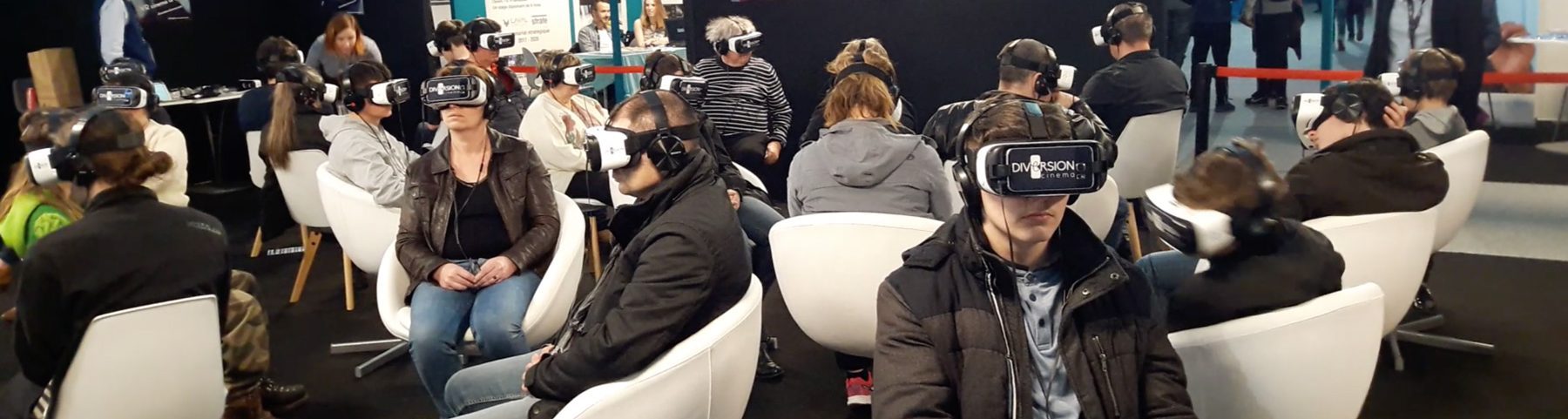
- A solo experience. In immersion, you're plunged into the world of the Matrix, but less thrilling. Neo without Morpheus just isn't the same film. You don't share, you don't communicate, you don't go from surprise to surprise together. You go it alone! A sad kind of visit? (See the illustration photo, taken at the Laval Virtual 2017 trade show, on a stand next to mine.)
- But the worst obstacle is surely tied to the hygiene issues that really need to be talked about… there's a strange silence on the subject. What about the risk of contamination from the headset touching the face: eye/nose/mouth mucous membranes? Who's to say the person who wore the headset before you didn't have the flu or a sore throat?
The upsides: some fine exceptions
Alright, to be honest I have to admit that VR headsets are well worth it in certain situations:
- When they enable training for professionals facing situations that are new, dangerous, or normally inaccessible. For example, technicians can be trained, from a safe location, to repair a technical component of a nuclear power plant.
- Gaming. Some video game fans are willing to break the bank and brave their seasickness to immerse themselves in their games for hours on end.
- Real estate, architecture, or the design of retail spaces. These simulations bring real added value at the design or presentation stages.
- Medical, for treating certain phobias. Or exploring anatomy from a cell's point of view.
So, apart from a few exceptions, does that mean we should drop any idea of immersion in a virtual world? Of course not. For now, and until the technology evolves, I believe in an alternative that's truly accessible and harmless for the general public. A technology we also bet on 4 years ago, and which successfully equips many of our clients, such as the labs Kyowakirin, Nordic Pharma, Teva, FloraMaroc and museums like those in Nice or Martigues.
An alternative: virtual reality in touch mode?
Okay, touch-based virtual reality on tablets or touch tables is less immersive. But it can be left in open access for the general public. And the experience offers other riches. You can handle 3D objects as you please. Trigger a phenomenon, activate a mechanism, admire the result from every angle, simply by touching your fingers to the screen. Unlike VR headsets, we can all experience this virtual reality without putting our health or our finances at risk.
And you, what's your experience with VR headsets?
Are you convinced? Or do you disagree? Let's talk about it!