STORYTELLING: VISUAL SCIENCE COMMUNICATION AT THE HEART OF THE NARRATIVE.
Today, every professional in the scientific field has something to say to explain and teach their research, share their innovations, draw attention to their mission, strengthen a funding application...
But contrary to popular belief, science in general (and the communication that takes it as its subject) is not entirely at odds with the realm of imagination or storytelling.
Quite the opposite: much like Albert Einstein and his flashes of intuition, researchers draw on their imagination to solve problems and advance their scientific work. Just as a researcher must imagine experiments before carrying them out, sharing the results of those experiments also relies on a form of storytelling, following a strict yet inventive protocol.
So how do you effectively narrate a scientific experiment or result? Who has the skills to do it? What does “storytelling” really mean, and what are its benefits in science communication?
NARRATE TO COMMUNICATE, IMAGINE TO UNDERSTAND
Storytelling means putting something into story form, telling a story. It is a communication method that uses the narrative structure of discourse in the shape of a short story.
As mentioned above, imagination should not be separated from the scientific process, since it is what allows us to advance our thinking and thus understand the world around us.
A great favourite of Einstein’s, “thought experiments” (in German: Gedankenexperiment) have no other purpose than to clearly illustrate certain counter-intuitive relativistic phenomena. Indeed, putting an image behind a phenomenon that is difficult to understand, invisible or imperceptible, allows us to rationalise it, perceive it better and begin a process of logical reasoning.
The familiar phrase “wait, let me show you!” seems, for example, to be the intuitive, visual solution when it is hard to communicate a complex subject out loud. Likewise, we often try to represent mechanisms invisible to the naked eye as diagrams or infographics in order to grasp the infinitely large or small.
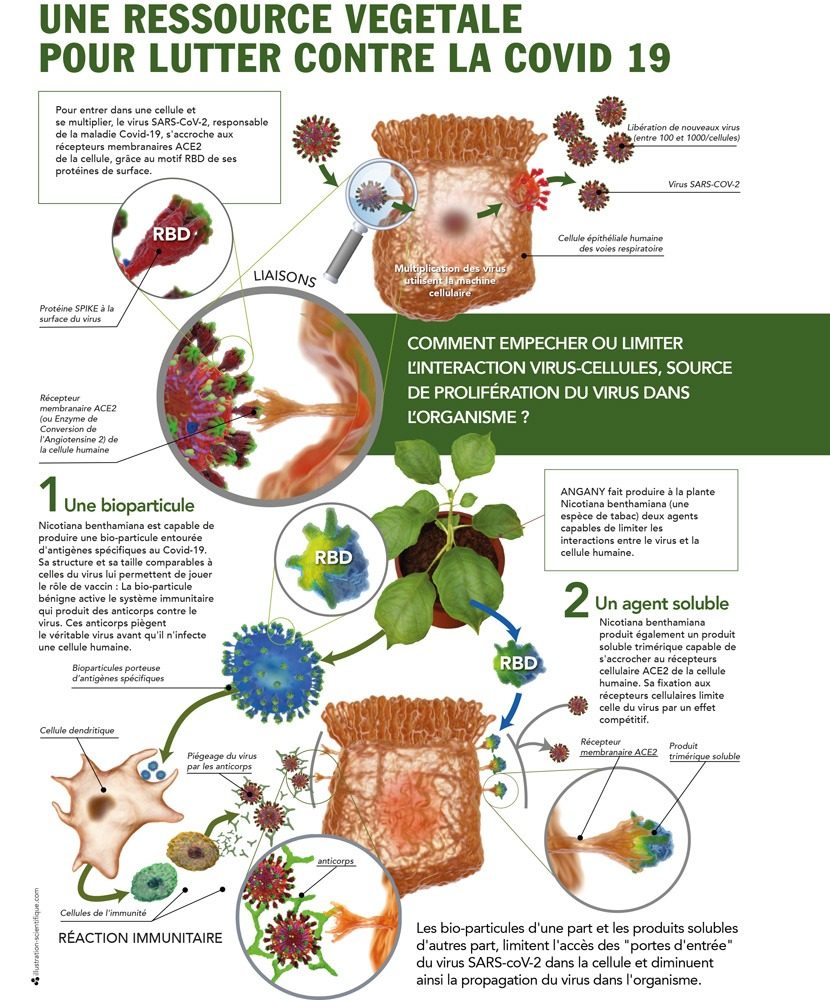
Angany laboratory This infographic conveys the biomechanical workings of a plant-derived molecule used to fight Covid-19.
What impact does scientific storytelling have on memorisation?
It is worth knowing that our imagination is, in a sense, made up of a succession of mental images. Neurological studies actually show that the brain regions activated when someone imagines are roughly the same as those involved in real visual perception.
If you add a logic or a coherent story to this sequence of images, you arrive at the principle of structured thought. Everything then takes on meaning and can lead to the understanding of a complex phenomenon.
What’s more, the principle of a logical sequence also makes learning easier for the human brain. Who has never used a mnemonic to aid memorisation, like the famous ones we all learned at school to remember grammar rules?

The idea of communicating scientific content (which often seems, sometimes wrongly, complex) through images and stories makes it possible, on the one hand, to make a scientific concept accessible, and on the other, to hold attention through an accurate and coherent representation, to raise awareness, spark curiosity or generate interest in the subject.
The aim of storytelling is therefore also to introduce emotion, to make people want to follow the story and learn a little more. The human brain is naturally receptive to storytelling, because it is predisposed to think, understand and create meaning from narrative.
That is why scientists, pharmaceutical and biotech specialists turn to science communication experts to showcase their work and position their brand in therapeutic fields.
So what is the added value of a communication agency specialised in sharing scientific information?
I ALREADY HAVE A COMMUNICATION AGENCY. WHY WORK WITH A SCIENTIFIC STORYTELLING AGENCY?
Not all communication agencies serve the same goals; each has its own specialities. Where a conventional communication agency might announce the dates of your next highly complex conference on “Neuromorphic computing via the nonlinear dynamics of spin waves”, a science communication agency can actually talk about it (and get others talking about it)!
Storytelling is indeed used by many communication agencies. But truly mastering that narrative in the service of a scientific concept is where the added value lies. Sharing scientific information involves certain strict conventions depending on the target audience. The vocabulary used to describe biological or technical phenomena must be carefully chosen and varies according to who you are addressing.
As such, the almost playful side of communication must not obscure the seriousness of rigorous scientific information. In other words, the substance (a fact or a proven truth) cannot be diminished by the form.
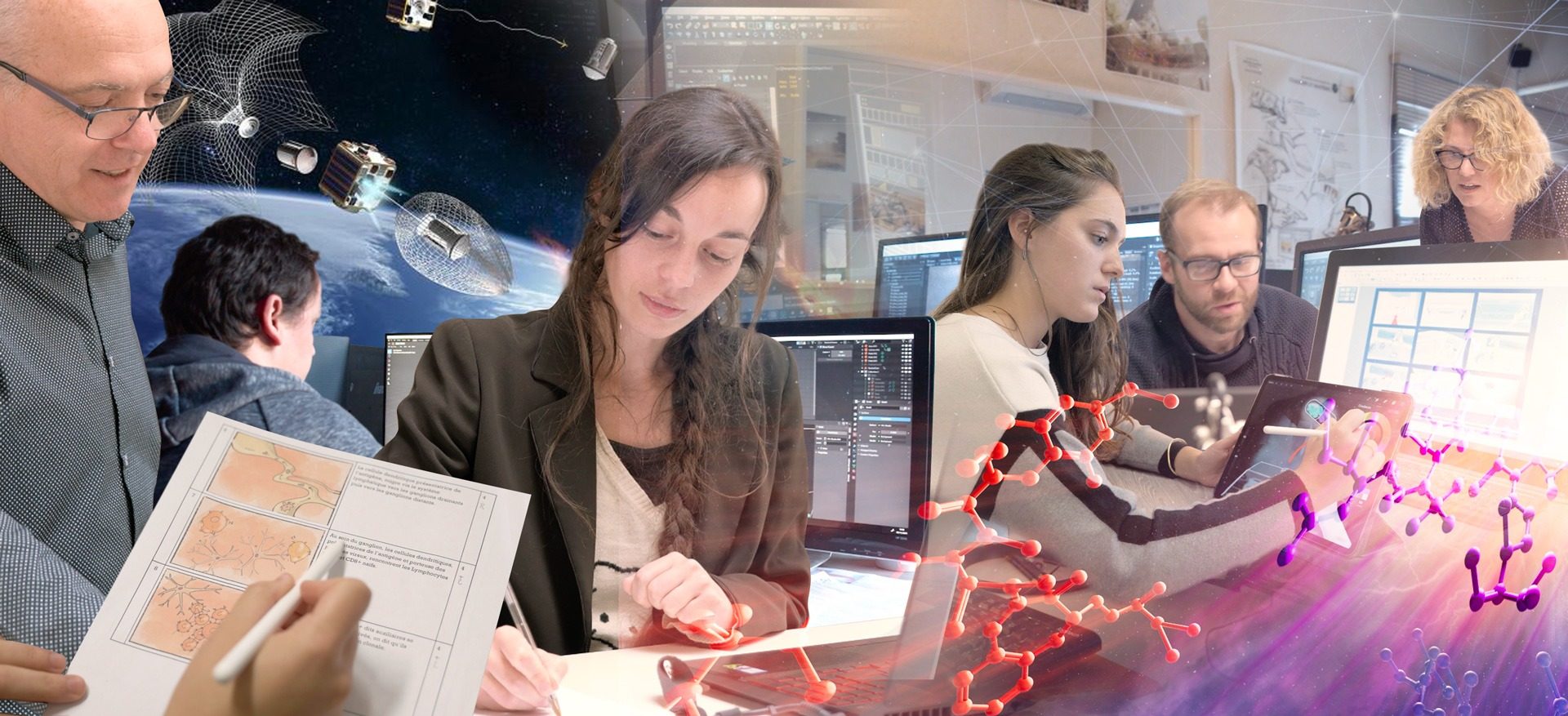
The role of a science communication agency is therefore to make the public understand and engage through visual, dynamic communication, without slipping into science fiction or falsehood. Much like a scientist, a communicator follows a precise protocol, for example by building a coherent narrative through a storyboard.
In conclusion
While science communication, for the sake of understanding and learning, must be engaging (even playful depending on the intended audience), it must also, in this field more than ever, demonstrate rigour.
Delivering the right message, to the right people, at the right time, with the right communication medium and backed by in-depth scientific knowledge: this is the whole challenge for a science communication agency in meeting the needs and goals of every scientist or pharmaceutical company.
Sources:
https://www.youtube.com/watch?v=YVYSFl4M5B8
http://www.slate.fr/story/160549/premier-memes-de-lhistoire
https://www.scienceshumaines.com/de-la-vision-a-l-imagination_fr_13502.html

Louise Sudour
Science Communicator
at Imascience