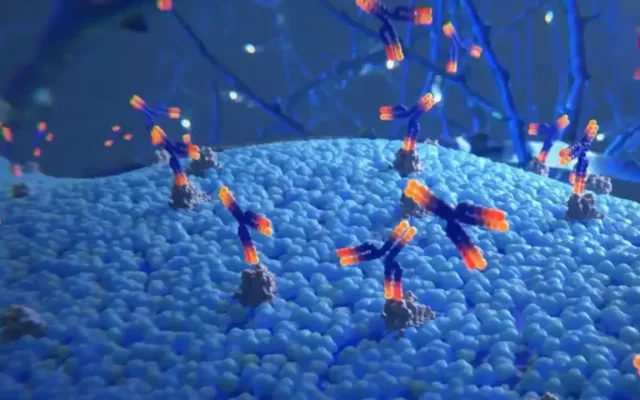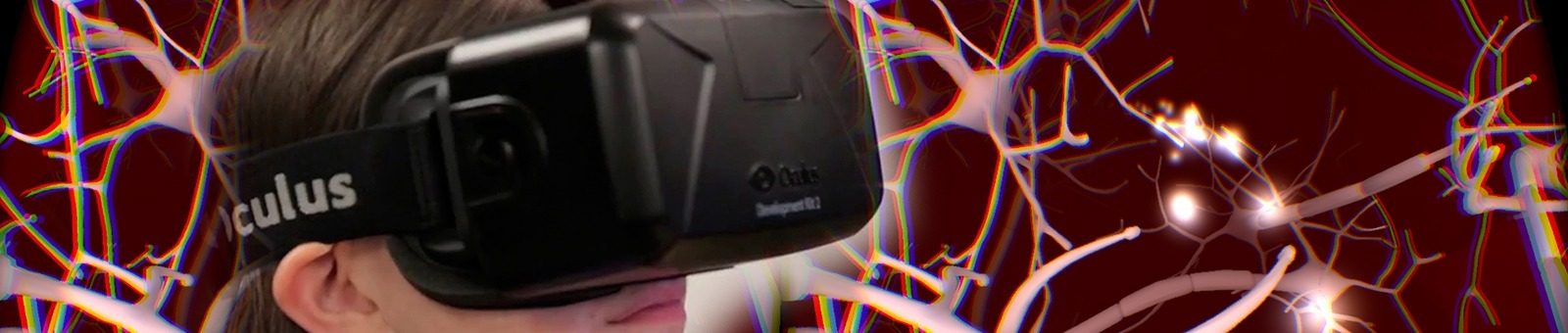
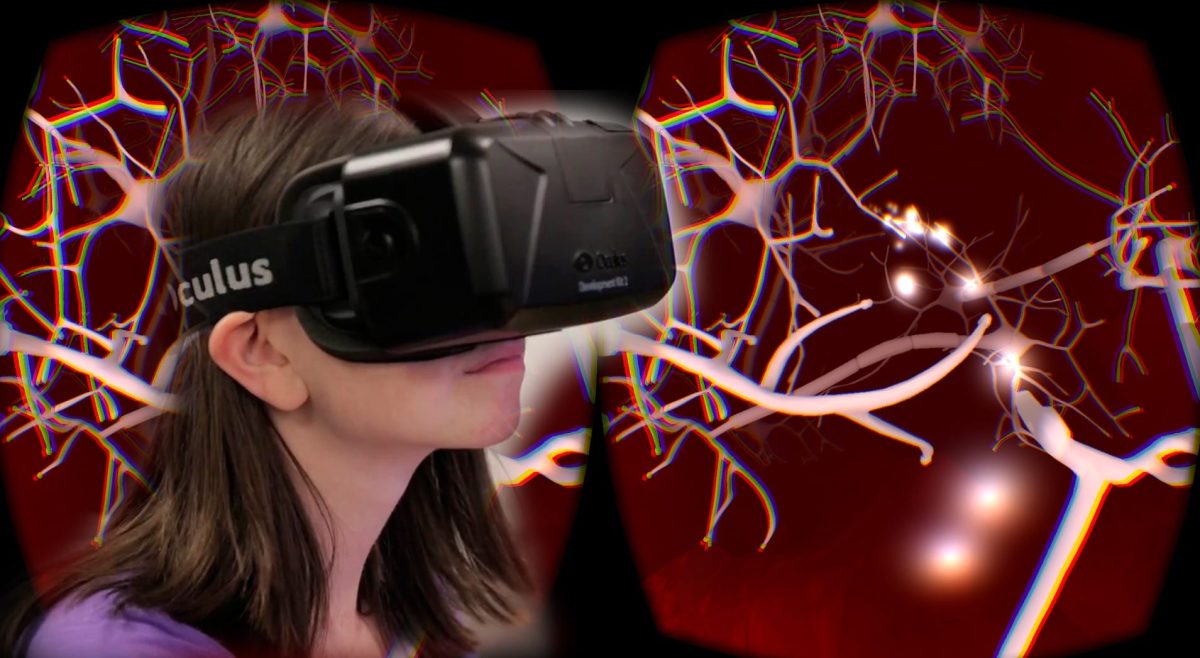
While video games and the film industry often come to mind when talking about virtual reality, another field could also be transformed by this technology: the pharmaceutical and medical industry. The pharmaceutical company ProStrakan presented, at the 14th SFETD national congress, a virtual reality experience showing how its molecule acts inside the human body itself.
ProStrakan invited congress visitors to travel inside the human body, in real-time 3D, following the path of the active molecule used to treat pain: Fentanil. Once again, ProStrakan placed its trust in the Imascience team to deliver the project from A to Z. 3D modelling, animation, real-time programming, and the supply and setup of the required equipment: two second-generation Oculus Rift headsets were available on the stand throughout the three days of the congress, and Imascience also handled the installation and launch of the experience on the stand.
The tools for virtual reality:
Various 3D modelling software, the Adobe suite for compositing, illustration and image retouching, sound design, voice-over recording, mixing, integration and programming in Unity 3D, and full HD rendering on Oculus Rift. On the stand, two mid-range laptops.
The storyline: seen from the point of view of a fentanyl molecule
1) Zoom in on the oral mucosa, where we (the fentanyl) pass between two lipoproteins.
2) We reach the bloodstream.
3) We head towards the heart, entering the right atrium through the superior vena cava.
4) We are propelled into the pulmonary artery, then cross the pulmonary alveoli.
5) Back to the heart through the left ventricle, then the aortic valve and the carotid artery.
6) We arrive in the brain after crossing the blood-brain barrier.
7) We navigate among the interconnected neurons to the target area, settling at a synapse.
8) Finally, we see the pain-relieving action.