France, the country of Pasteur, is also the country with the highest number of people reluctant to be vaccinated against Covid-19. The arrival on the market of a new type of vaccine, the messenger RNA vaccine (or mRNA), has raised questions and concerns. How does this new vaccine work? What are its advantages and disadvantages? Does the mRNA vaccine alter our genome, turning us into Genetically Modified Organisms (GMOs)?
Here are some explanations to shed light on the subject and fight against misconceptions.
How does a vaccine work?
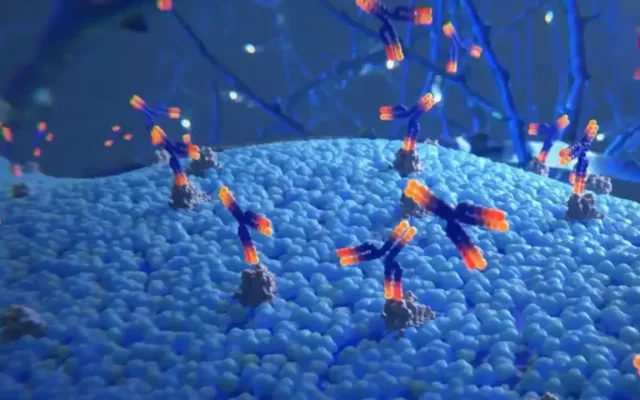
The purpose of an antiviral vaccination is to prepare our body for infection by a virus, in order to prevent the development of the associated disease. This is achieved by injecting into the body an inactivated form of the virus or its components. This way, our immune system, exposed to the “fake virus”, develops so-called “memory” cells. When the real virus appears, these will be able to recognise and fight it faster, even before the first symptoms show. It is, in fact, a preventive decoy.
3D animation video (a project by Imascience) explaining how vaccination against a virus works (here, the influenza virus).
How is the mRNA vaccine (*) different from a “classic” vaccine?
Recently, in the case of Covid-19, the disease caused by the SARS-CoV-2 virus, a brand-new type of vaccine was brought to market: the mRNA vaccine (*). This is the case for the vaccines developed by Pfizer-BioNTech and Moderna. This new type of vaccine has the same “immune memory” objective as a classic vaccine, but does not act in exactly the same way. This time, the aim is to have the viral fragments produced directly by the cells of the vaccinated person, rather than manufacturing them in a laboratory and then inoculating them. Indeed, our cellular machinery is able to read the genetic information carried by the supplied mRNA in order to produce the corresponding “decoy proteins” itself.
What are the advantages of the mRNA vaccine?
Having viral proteins (those famous decoys) produced by the patient’s cells avoids certain complex laboratory steps of “manufacturing” an inactivated virus. Synthesising only the required mRNA strand is much simpler, faster and more adaptable to any type of virus, as long as its genetic code is known.
Moreover, because the vaccine is made of mRNA (Ribonucleic Acid), the immune system is stimulated without the need to add extra substances to boost vaccine efficacy. These substances, called adjuvants, have sometimes been blamed for triggering autoimmune reactions. As a result, mRNA vaccines, which contain no adjuvants, are better tolerated by the body.
How was it possible to develop a new type of vaccine so quickly?
Manufacturing a vaccine involves numerous validation phases and clinical trials that often last several decades. Nevertheless, faced with the Covid-19 pandemic, the search for a vaccine proved urgent and a priority. The mRNA vaccine candidates were developed in record time and raised questions among the public: “Are these new vaccines dangerous? How do they act in our body? Does this new mRNA method alter our genome?”. While this is the first time that infectious mRNA vaccines have been used in humans, they have been known and studied for many years. The time and money devoted to the search for such a vaccine against SARS-CoV-2 explain how quickly it was rolled out. But rest assured, the usual ethical protocols obviously had to be respected.
“The new mRNA vaccine may alter our genome”: really?
After being vaccinated against Covid-19, do we become Genetically Modified Organisms? The fact that genetic material in the form of mRNA modified by humans is inoculated into the patient can very quickly give rise to false misconceptions. However, several biological facts explain why the mRNA introduced into our body does not alter our genome (that is, the genetic information contained in our DNA):
- The mRNA is rapidly destroyed after being read by the patient’s cellular machinery. It does not persist in our cells.
- The information contained in the mRNA cannot be passed from one generation to the next. Indeed, the vaccine injection is local and does not reach the cells of the reproductive organs.
- In all cases, the mRNA remains in the cytoplasm of the cells (where proteins are produced) and does not enter the nucleus containing our DNA.
- In humans, mRNA cannot be turned into DNA. Indeed, we do not possess the enzyme required for this action. No foreign gene can therefore be inserted into our genome.
- The cells that receive and produce the viral proteins are rapidly destroyed by the immune system. The foreign RNA therefore does not stay in the body for long: just long enough to serve as a template for protein production and to trigger an immune response against these proteins, before being eliminated.
So, even after the vaccine is injected, the nucleus of our cells continues to contain only our natural human DNA.
What is the technical challenge of an mRNA vaccine?
While the fragility of mRNA is an argument for its short presence in the body, it is also a challenge for managing vaccine stocks. Above a certain temperature, mRNA can “break”. This is why it is essential to store these vaccines at very low temperatures.
Where do we stand? The vaccination of the French in a few figures.
For a patient’s vaccination to be complete, two doses three weeks apart must be administered.
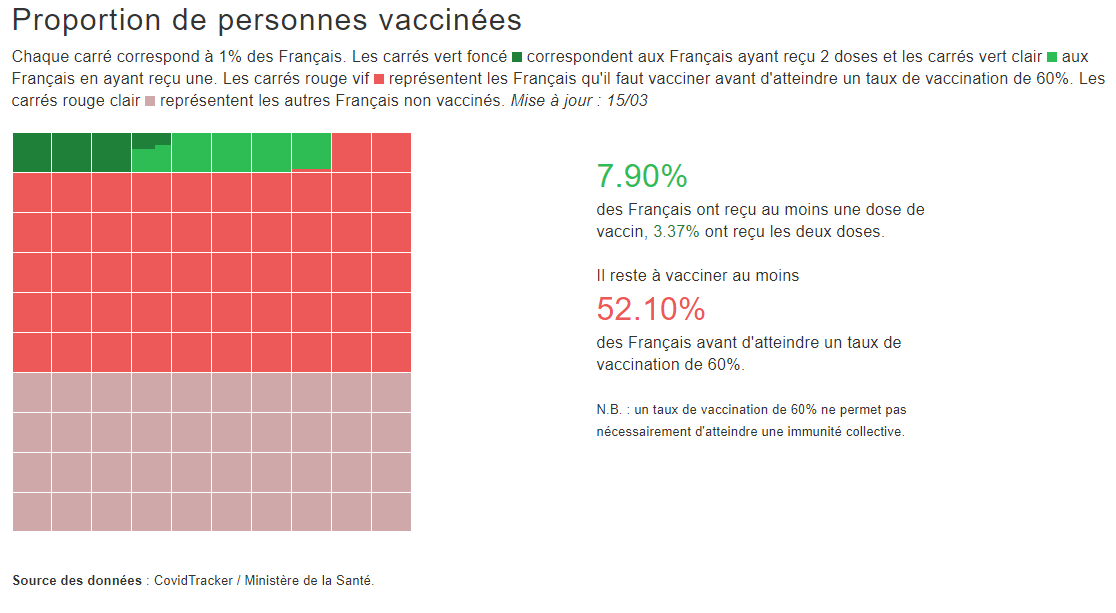
According to figures from the French Ministry of Health, to date (15/03/2021), only 3.37% of the French have received the two required doses of vaccine. 7.90% have received at least one dose. A major effort in the vaccination campaign is therefore needed if we are to achieve herd immunity (more than half the French population still needs to be vaccinated).
As France is currently in an emergency situation regarding vaccination, people who have already contracted the virus receive only a single dose of vaccine. Indeed, their body has already been in contact with the virus, which can, in a way, “replace” the first dose of vaccine.
To follow the Ministry of Health data in real time, you can visit https://covidtracker.fr/vaccintracker/
(*) mRNA: a “messenger” ribonucleic acid molecule, carrying the genetic information needed for protein synthesis.
Sources:
https://presse.inserm.fr/les-vaccins-a-arnm-susceptibles-de-modifier-notre-genome-vraiment/41781/
https://www.nejm.org/doi/full/10.1056/NEJMoa2034577?query=featured_home
https://www.pasteur.fr/fr/sars-cov-2-covid-19-institut-pasteur/projets-recherche/covid-19-vaccin-adn
https://covidtracker.fr/vaccintracker/
DO YOU HAVE A SCIENTIFIC COMMUNICATION PROJECT?

Louise Sudour
Science Communicator
at Imascience