Short excerpt from the article: The conquest of the galaxy is under way.
Read it in Science & Vie No. 1179, December 2015.
http://www.science-et-vie.com/2015/11/au-sommaire-de-science-vie-n1179/
Two years after the laser was invented (1960), physicist Robert Forward proposed using photon pressure to propel sailing craft through space.
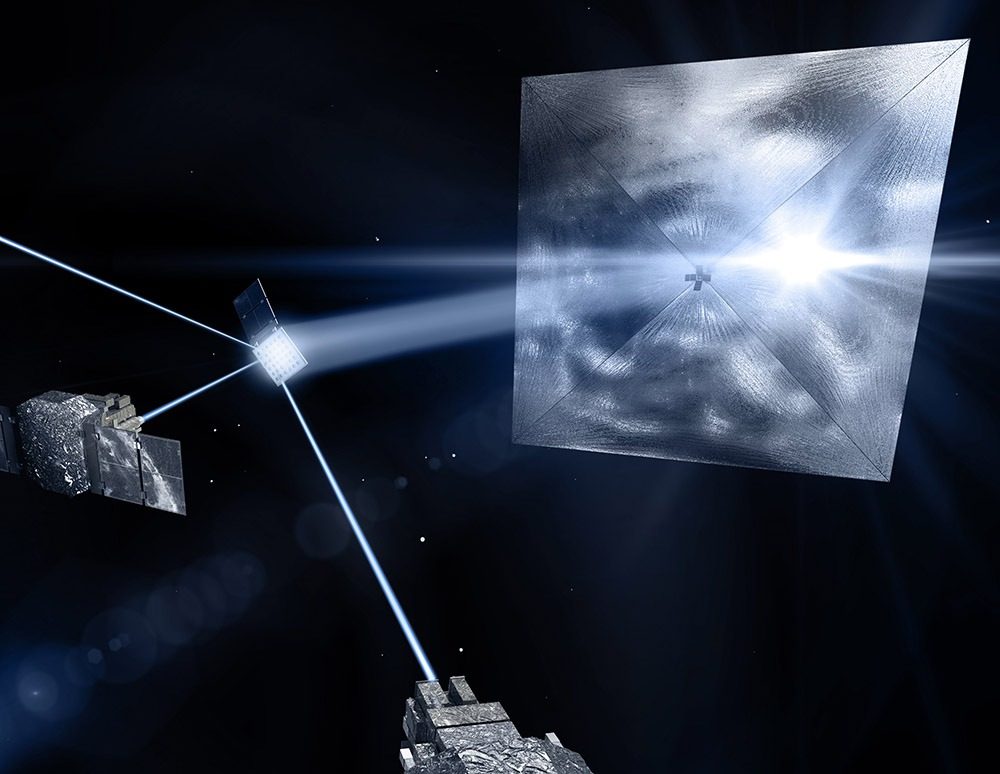
Laser power, beam focusing, sail materials… For twenty years he studied dozens of concepts and eventually sized a typical mission: a 65 GW laser aimed at a 3.5 km sail could carry a one-tonne vehicle to Alpha Centauri in under forty years.
The mission was revisited under NASA's advanced concepts program in the late 1990s by Geoffrey Landis, of the Ohio Aerospace Institute, who concluded that none of the difficulties made the project impossible.
The laser-propelled interstellar sailship
The advantages of the concept (the craft needs no fuel, and the laser, being stationary, can be repaired as needed) have earned solar sails several tests: in 1993 the Russian space agency deployed one; in 2010 the Japanese probe Ikaros demonstrated propulsion and attitude control…
What remains is to scale the sails up from around ten metres to a kilometre, and to put a solar-powered laser into orbit.
“It's just an extrapolation of proven techniques,” reckons Les Johnson, a solar sail specialist at NASA. The biggest problem in fact lies in the colossal power required (on the order of the world's annual energy consumption)… unless you opt for micro-craft.
Probes so miniaturized they could even be built into the very structure of a sail: with a 10 g probe you can reach Alpha Centauri in fifty years; with 1 g, in just twenty years, calculates Philip Lubin, of the University of California, tasked by NASA with drawing up a roadmap to make this project a reality.
All the more so as lasers could be miniaturized and used in swarms. An armada of lasers to propel fleets of microsatellites…
Excerpt from the article: The conquest of the galaxy is under way. Read it in Science & Vie No. 1179, December 2015.
http://www.science-et-vie.com/2015/11/au-sommaire-de-science-vie-n1179/